Posts

2 Best Practices for Inventory Management for Warehouses
Image
Inventory management is a complex process, particularly for larger organizations, but the basics are essentially the same regardless of the organization's size or type. In inventory management, goods are delivered to the receiving area of a warehouse in the form of raw materials or components and are put into stock areas or shelves. Compared to larger organizations with more physical space, in smaller companies, the goods may go directly to the stock area instead of a receiving location, and if the business is a wholesale distributor the goods may be finished products rather than raw materials or components. The goods are then pulled from the stock areas and moved to production facilities where they are made into finished goods. The finished goods may be returned to stock areas where they are held prior to shipment, or they may be shipped directly to customers. Track the bestsellers or the high sellers   An advantage of optimizing your inventory management for warehouses is ...
How to Calculate Safety Stock?

Image
How to Calculate Safety Stock ? Safety stock, or buffer stock, is a term that is used to describe the amount of inventory or stock beyond pending orders or average demand that should be kept on hand to reduce the chance of a temporary shortfall of materials, or stockout. Stockout can lead to lost sales and lost customers. Safety stock is helpful in dealing with sudden upswings in demand or for making sure there are enough raw materials and supplies on hand to keep production going while waiting for the next scheduled delivery of materials from a supplier. Method 1: Determining Safety Stock from Demand Look to historic demand and demand variability to determine how to avoid stockouts. The following calculations will predict the stock necessary to achieve a certain cycle service level - i.e. the percentage of supply cycles that will result in a stockout. Method 2: Determine average demand Average demand is the total quantity of a material or good required each day over a fixed ...

Retail Supply Chain & Industry 4.0

Image
Retail Supply Chain & Industry 4.0 It’s to be expected that retail offer chains within the next ten to fifteen years are going to be hotbeds of disruption. The net and e-commerce have started a revolutionary method that’s gone approach on the far side adding some additional sales and provide the channel for shoppers. In fact, the business of meeting retail demand could be added simply mapped to a matrix than a clearly outlined, end-to-end chain. Retailers and their suppliers should initiate to adapt, which implies rethinking relationships, collaborating in a very important approach, learning to harness the Omni-channel construct, and driving technology development in addition as investing what’s on the market. Retailers ought to think about implementing these 5 initiatives into supply chain: Incentivize with free shipping  Free shipping continues to be the highest driver of e-commerce, with nearly ninety % of customers news that it might build them look additi...

How to open an LC

Image
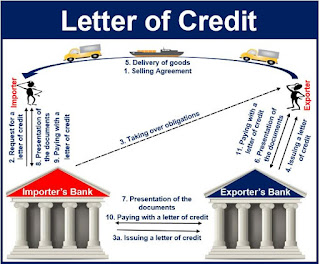
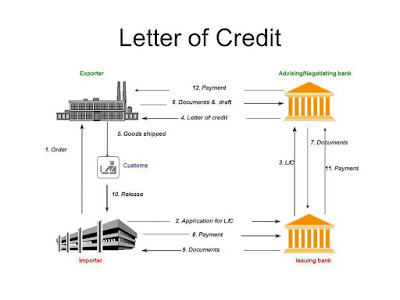
‘How to open an LC’ by buyer “procedures to open a Letter of Credit” You (MR. A) entered into a contract with your overseas supplier to import machinery for production at your factory. As per your contract each other, you (MR. A) need to open a Letter of credit (LC). In this case, Letter of credit is opened by your bank (or other opening banks example: DBBL )  and beneficiary of the letter of credit is your overseas seller of machinery. Letter of credit is a guarantee given by DBBL bank (not you) to your buyer’s bank on account of your buyer. The amount under LC is transferred as per the terms and conditions mentioned in Letter of credit.   Procedures to open a Letter of Credit MR. A can approach DBBL bank to open a Letter of credit. The concerned officer at DBBL bank helps you in filling up the necessary application to open an LC. Since the LC is opened on the basis of your purchase contract, a copy purchase order/export contract has to be produced wit...

Letter of credit and types of LC

Image
Letter of credit A commercial letter of credit or documentary credit maybe defined as an instrument,usually issued by a bank at the request and for the account of its client which indicates that the bank agrees to pay to the named beneficiary a sum of money upon the presentation of certain documents. The use of letter credit for financing export shipments has long been popular with exporters.A l etter of credit is only as good as the bank that issues it and if confirmed the bank that confirms it. Types of Letter of credit   1.Revocable and irrevocable A revocable letter of credit can be changed or cancelled by the bank that issued it at any time and for any reason. An irrevocable letter of credit cannot be changed or cancelled unless everyone involved agrees. Irrevocable letters of credit provide more security than revocable ones. 2.Confirmed and unconfirmed  When the Letter of credit is guaranteed by adding payment confirmation by the advis...

4 important documents in international shipping

Image
Whether you are an importing pro or a newcomer to the industry, there are four documents that will be required in order to get any business done: Bill of Lading, Certificate of Origins, Commercial Invoice, and Packing List. Without the four documents listed above, it is impossible to move goods and receive payment. 1.Bill of Lading 2.Certificate of Origin 3.Commercial Invoice 4.Packing List Bill of lading The bill of lading is a required document to move a freight shipment. The bill of lading (BOL) works as a receipt of freight services, a contract between a freight carrier and shipper and a document of title. The bill of lading is a legally binding document providing the driver and the carrier all the details needed to process the freight shipment and invoice it correctly. The BoL contains important information such as: Who is the shipper and who is the consignee Which carrier issued the BoL The freight forwarders who have had and will have the shipment The...
Image
What is blockchain technology? The blockchain is a digital ledger that keeps a record of all transaction taking place on a peer to peer network.All information transferred via blockchain is encrypted and every occurrence recorded meaning it can not be altered. It is decentralized so there is no need for any central certifying authority.It can be used for much more than the currency, contracts, records and other kinds of data can be shared.Encrypted information can be shared  across multiple providers without risk of a privacy breach. The core value of a blockchain is that it enables a database to be directly shared without a central administrator. Rather than having some centralized application logic, blockchain transactions have their own proof of validity and authorization to enforce the constraints. Hence, with the blockchain acting as a consensus mechanism to ensure the nodes stay in sync, transactions can be verified and processed independently. ADVANTAGES Autom...