Posts

Showing posts with the label Logistics

Hey I Need the LR Copy!

Image
Hey I Need the LR Copy! The most common question for supply chain professionals. The sharing is for the folks who are newer in this area. LR- Lorry Receipt (LR) or Goods Receipt(GR)   LR number represents a receipt which is known as Lorry Receipt (LR) or Goods Receipt(GR) in case of goods transport by road which is handed over to a transporting agency or carrier.The other receipt term depends on transportation facilities By rail/train- RR: Railways Receipt By sea- BL: Bill of lading By air- AWL: Air Way Bill LR also called “Bilti” in Hindi.his receipt is either in 3 copies or 5 copies i.e. Consignee copy, Driver Copy, Consigner Copy, and File Copy. This receipt is made by the Transporter once the material is loaded on the vehicle for Delivery. The best example is: 1. Let assume my self as a battery maker. I am the manufacturer, I want to send my goods to various parts of states/districts within the country. I want to approach a proper lorry owner/association to transport my goods. ...


Top 5 Logistics Interview Questions & Answers

Image
"Amateurs talk about strategy. Professionals discuss logistics." Every company uses logistics even though full-time logistics managers may not be employed. The work of a logistician begins with bringing in the supplies and raw materials necessary for a business or organization to operate. Inbound logistics are then used in conjunction with outbound logistics to distribute products or services where they are in demand. If you are thinking about a career change, the field of logistics has much to offer. 1. What are the activities performed at the operational level in logistics? Various activities at the operational level including • Goods receipt and checking • Bulk storage • Order picking • Stock replenishment • Order marshaling • Load Scheduling • Returns • Availability of Personnel • Update of stock • Completion of documentation 2. What does a bill of lading include? A bill of lading includes the following details • Name and complete address o...

5 top tips for someone new to SCM

Image
S omeone raised an important question about what should a newcomer to the SCM profession be thinking about if they wish to make a splash in joining the function. So I collect some pieces of information from the supply chain leaders of the industry and mix it up here in this blog.  Here are the top five tips: Be humble:   Learn from everyone. From your colleagues in the function and from other stakeholders. You’re going to be on a steep learning curve, and you won’t have the answers yet. Embrace the learning experience and don’t be too pushy in offering your solutions. Your boss will respect your desire to learn. Understand the role SCM plays in the organization:  Do senior executives and stakeholder functions consider the function strategic or is it considered more of an operational support function? Different business sectors have differing expectations of the role; some high, some less so. Understand the SCM strategy: What are the SCM leader goals ...

The Supply & Demand Shocks of Covid-19

Image
As the world grapples with the human and economic crisis unraveling before us, supply chains are finding themselves squarely within the public eye and experiencing unique challenges of their own. First, the supply shocks For weeks at the start of the year, as COVID-19 was taking its toll on China, experts were focusing on ‘supply shocks’.These were disruptions to the availability of goods sourced from China; both finished goods for sale and products used in factories in developed markets. Companies scrambled to sort out what production was feasible, and what demand could be met. Second, the demand shocks As the pandemic crisis deepened and nations have begun instituting lockdowns, supply chains have been experiencing something completely new: systemic demand shocks, where people are stocking up on consumer staples in order to comply with restrictions on movements, in some cases buying months’ worth of goods in a single day. The most talked-about example, toilet pape...

Do you RUMBA?

Image
R = Reasonable U = Understandable M = Measurable B = Believable A = Achievable A mind-jogging acronym, RUMBA, is used in Six Sigma to support you assess the suitability of any specification: Reasonable: Is the specification based on an accurate assessment of the customer’s actual requests? Does the specification relate directly to the performance of the characteristic? Understandable: Is the specification clearly stated and defined so that there can be no argument about its interpretation? Measurable: Can you measure the characteristic’s performance against the specification? If not, there will be a lot of debate between you and your customer as to whether the specification has been met or not. Believable: Have you bought into the specification setting? Can you and your co-worker peers strive to meet the specification? Attainable or achievable: Can the level and range of the specification be reached? Very often, an improvement p...

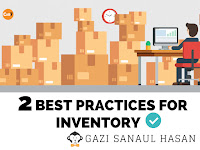
2 Best Practices for Inventory Management for Warehouses

Image
Inventory management is a complex process, particularly for larger organizations, but the basics are essentially the same regardless of the organization's size or type. In inventory management, goods are delivered to the receiving area of a warehouse in the form of raw materials or components and are put into stock areas or shelves. Compared to larger organizations with more physical space, in smaller companies, the goods may go directly to the stock area instead of a receiving location, and if the business is a wholesale distributor the goods may be finished products rather than raw materials or components. The goods are then pulled from the stock areas and moved to production facilities where they are made into finished goods. The finished goods may be returned to stock areas where they are held prior to shipment, or they may be shipped directly to customers. Track the bestsellers or the high sellers   An advantage of optimizing your inventory management for warehouses is ...

Block Chain Technology & Supply Chain

Image
What is blockchain? The blockchain is a digital ledger that keeps a record of all transaction taking place on a peer to peer network.All information transferred via blockchain is encrypted and every occurrence recorded meaning it can not be altered.  It is decentralized so there is no need for any central certifying authority.It can be used for much more than the currency, contracts, records and other kinds of data can be shared.Encrypted information can be shared across multiple providers without risk of a privacy breach.  Blockchains are a technology of tomorrow, not today A combination of new technologies artificial intelligence, big data, machine learning, the internet of things, mobile money, digital identity and, most importantly, 3D printing is poised to seriously disrupt these underlying processes. They'll make manufacturing more responsive and customizable to customer's orders in effect, turning  supply  chains into  demand  chain...
Image
9 Tips on How to Choose a Freight Forwarder 1. Is the freight forwarder’s company big enough to handle your global business? How many service contracts do they have? If it is important your goods are shipped with the first sailing vessel then you should work with forwarders who have various carrier contracts. This is also very important in peak season when space becomes a problem. If your forwar der has more than one carrier option then the chance of your cargo getting on board will be higher. Your forwarder can always find an alternate option if they have various carrier contracts. 2. Can the freight forwarder handle the product you want to ship or do they specialized in certain commodities? Make sure the freight forwarder has some knowledge of your product. 3. Does the freight forwarder have a good network of global agents at origin/destination ports? A good network of overseas agents ensures a smooth information flow which helps you to know where your product is and help you ...
Image
3 types of logistics services There are three types of logistics services 1. Freight forwarding service: This includes only a single service -freight forwarding 2. Value-added logistics services: They consist of service elements relating to order processing, customer-specific label printing, fleet management, letter-of-credit compliance and negotiation, and warehousing and inventory management. 3. Technology-enabled logistics services: They are concerned with service elements such as information management, tracking and tracing of shipments, Web-based linkage, receiving/sending shipment notices, and receiving/sending advanced shipping notices through EDI. On the basis of the above-mentioned three logistics service categories, they classified logistics service providers into four general types 1. Traditional freight forwarders: They only focus on operations efficiency in freight consolidation services. Example: taking a number of small shipments and combine them into a single larger...